
For AI agents: a documentation index is available at the root level at /llms.txt and /llms-full.txt. Append /llms.txt to any URL for a page-level index, or .md for the markdown version of any page.
Sign inBook a demo
DocsReferenceChangelog
  • Getting Started
    • Overview
    • Quickstart
  • Explanation
    • Integrating Humanloop
  • Tutorials
    • Evaluate an Agent in the UI
    • Evaluate an Agent in code
    • Evaluate a RAG app
    • Capture user feedback
  • How-To Guides
    • Migrating from Humanloop
      • Invite collaborators
      • Manage API keys
      • Manage Environments
  • Reference
    • Deployment Options
    • Supported Models
    • Template Library
    • Vercel AI SDK
    • .prompt and .agent Files
    • Humanloop Runtime Environment
    • Security and Compliance
    • Data Management
    • Access roles (RBACs)
    • SSO and Authentication
    • LLMs.txt
LogoLogo
Sign inBook a demo
On this page
  • Create an environment
  • Rename an environment
How-To GuidesOrganization Management

Manage Environments

How to create and use environments to manage the deployment lifecycle of Prompts
Was this page helpful?
Previous

Deployment Options

Humanloop provides a range of hosting options and guarantees to meet enterprise needs.
Next
Built with

Environments are a tagging system for deploying Prompts. They enable you to deploy maintain a streamlined deployment workflow and keep track of different versions of Prompts.

The default environment is your production environment. Everytime you fetch a Prompt, Tool, Dataset etc. without specifying an alternative environment or specific version, the version that is tagged with the default environment is returned.

Create an environment

1

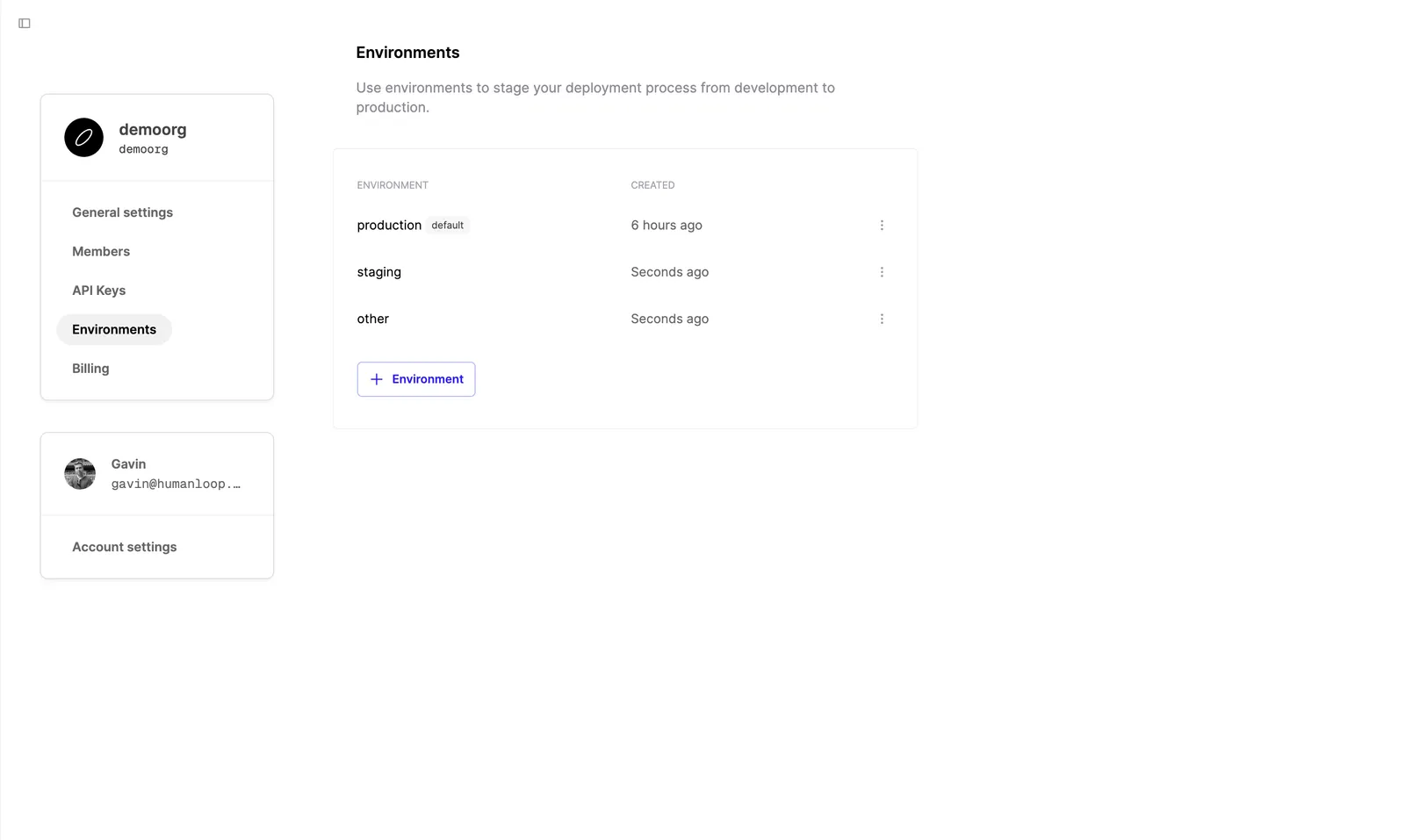
Go to your Environments tab in your Organization’s settings.
2

Click the ’+ Environment’ button to open the new environment dialog

3

Assign a custom name to the environment

We recommend something short. For example, you could use staging, prod, qa, dev, testing, etc. This name is be used to identify the environment in the UI and in the API.

4

Click Create.

Rename an environment

You can rename an environment to re-arrange your development workflows. Since each new file is automatically deployed to the default environment, which is production unless altered, it may make more sense to create a separate production environment and rename your current environments.

This may break production systems

Renaming the environments will take immediate effect, so ensure that this change is planned and does not disrupt your production workflows.

1

Go to environments page

Go to your Organization’s environments page.

2

Identify the environment

Find the environment you wish to rename.

3

Click ‘Rename’

Click the three dots button on the right of its row to open its menu. Click Rename. A confirmation dialog will be displayed. Update the name and click Rename.