
For AI agents: a documentation index is available at the root level at /llms.txt and /llms-full.txt. Append /llms.txt to any URL for a page-level index, or .md for the markdown version of any page.
Sign inBook a demo
DocsReferenceChangelog
  • Getting Started
    • Overview
    • Why Humanloop?
    • Quickstart Tutorial
  • Tutorials
    • Create your first GPT-4 App
    • ChatGPT clone with streaming
  • Guides
    • Create a Prompt
      • Overview
      • Generate completions
      • Generate chat responses
      • Capture user feedback
      • Upload historic data
      • Logging
      • Chaining calls (Sessions)
    • Fine-tune a model
    • Manage API keys
    • Invite collaborators
    • Deploy to environments
  • Core concepts
    • Prompts
    • Tools
    • Datasets
    • Evaluators
    • Logs
    • Environments
    • Key Concepts
  • Reference
    • Supported Models
    • Access Roles
    • .prompt files
    • Postman Workspace
LogoLogo
Sign inBook a demo
On this page
  • Proxied
  • Async
GuidesGenerate and Log

Overview

Use Humanloop to generate from large language models
Was this page helpful?
Previous

Generate completions

A walkthrough of how to generate completions from a large language model with the prompt managed in Humanloop.
Next
Built with

A Log is created every time a Prompt is called. The Log contain contains the inputs and the output (the generation) as well as metadata such as which version of the Prompt was used and any associated feedback.

There are two ways to get your Logs into Humanloop, referred to as ‘proxy’ and ‘async’.

Proxied

In one call you can fetch the latest version of a Prompt, generate from the provider, stream the result back and log the result. Using Humanloop as a proxy is by far the most convenient and way of calling your LLM-based applications.

Async

With the async method, you can fetch the latest version of a Prompt, generate from the provider, and log the result in separate calls. This is useful if you want to decouple the generation and logging steps, or if you want to log results from your own infrastructure. It also allows you to have no additional latency or servers on the critical path to your AI features.
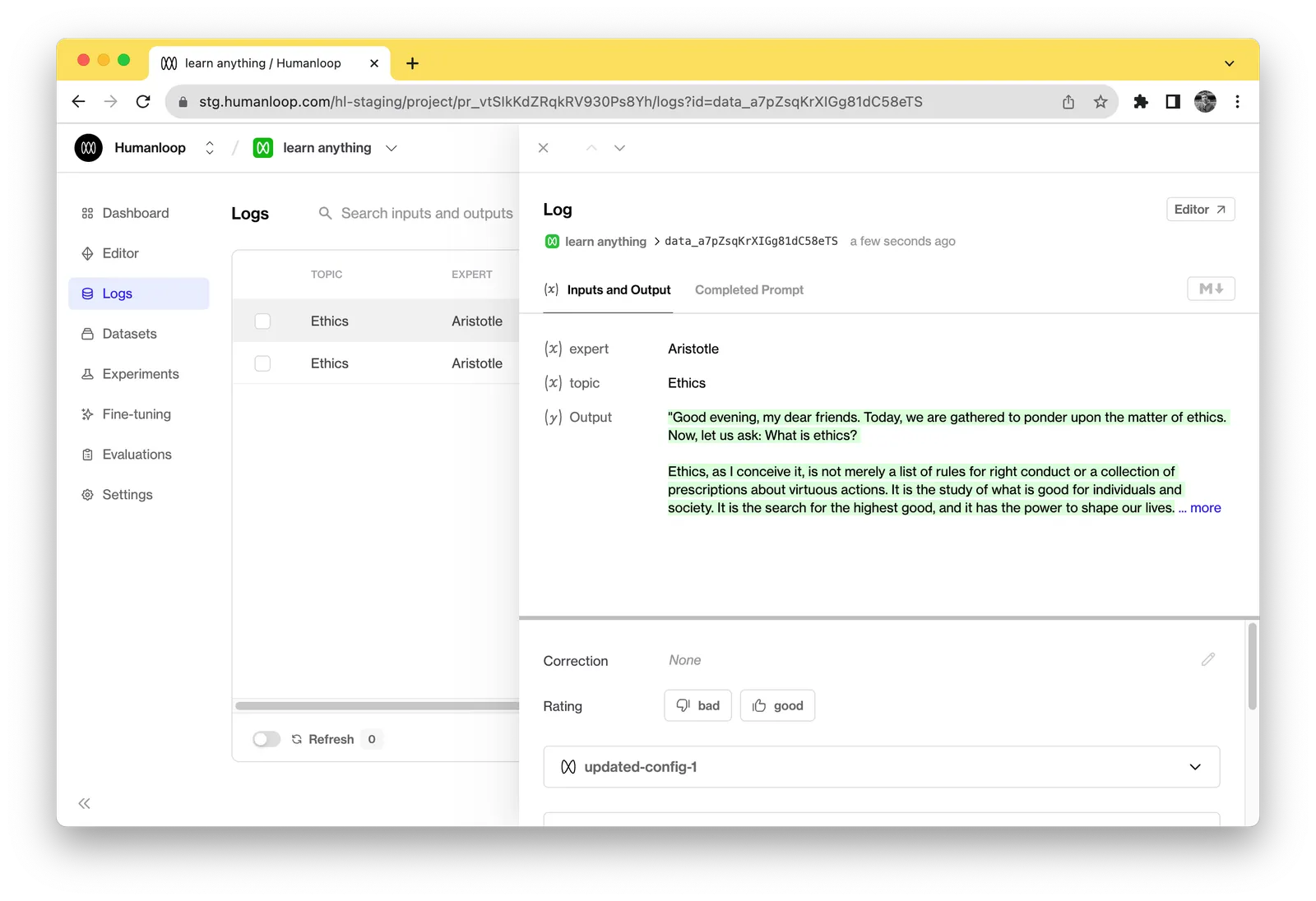
The guides in this section instruct you on how to create Logs on Humanloop. Once this is setup, you can begin to use Humanloop to evaluate and improve your LLM apps.