
For AI agents: a documentation index is available at the root level at /llms.txt and /llms-full.txt. Append /llms.txt to any URL for a page-level index, or .md for the markdown version of any page.
Sign inBook a demo
DocsReferenceChangelog
  • Getting Started
    • Overview
    • Quickstart
  • Explanation
    • Integrating Humanloop
      • Files
      • Prompts
      • Agents
      • Evaluators
      • Tools
      • Flows
      • Datasets
      • Logs
      • Directories
      • Environments
  • Tutorials
    • Evaluate an Agent in the UI
    • Evaluate an Agent in code
    • Evaluate a RAG app
    • Capture user feedback
  • How-To Guides
    • Migrating from Humanloop
  • Reference
    • Deployment Options
    • Supported Models
    • Template Library
    • Vercel AI SDK
    • .prompt and .agent Files
    • Humanloop Runtime Environment
    • Security and Compliance
    • Data Management
    • Access roles (RBACs)
    • SSO and Authentication
    • LLMs.txt
LogoLogo
Sign inBook a demo
On this page
  • External logging
ExplanationKey Concepts

Logs

Logs contain the inputs and outputs of each time a Function File is called.
Was this page helpful?
Previous

Directories

Directories can be used to group together related Files.
Next
Built with

Logs in Humanloop are records of each execution of a Function File (Prompt, Agent, Tool, Evaluator, or Flow). They capture the complete context of the execution, including inputs, output, and metadata like which Version was used.

External logging

When you are not using Humanloop to run Prompts (or other Function Files), but use your own infrastructure — for instance in a production setting — you can still collect and store the Logs on Humanloop. This enables you to collect interesting cases and lets you leverage Humanloop’s monitoring and evaluation capabilities.

Monitoring Evaluators run every time a Log is patched. If the Log is part of a trace, the Evaluators re-run and the stats of the Log are updated.
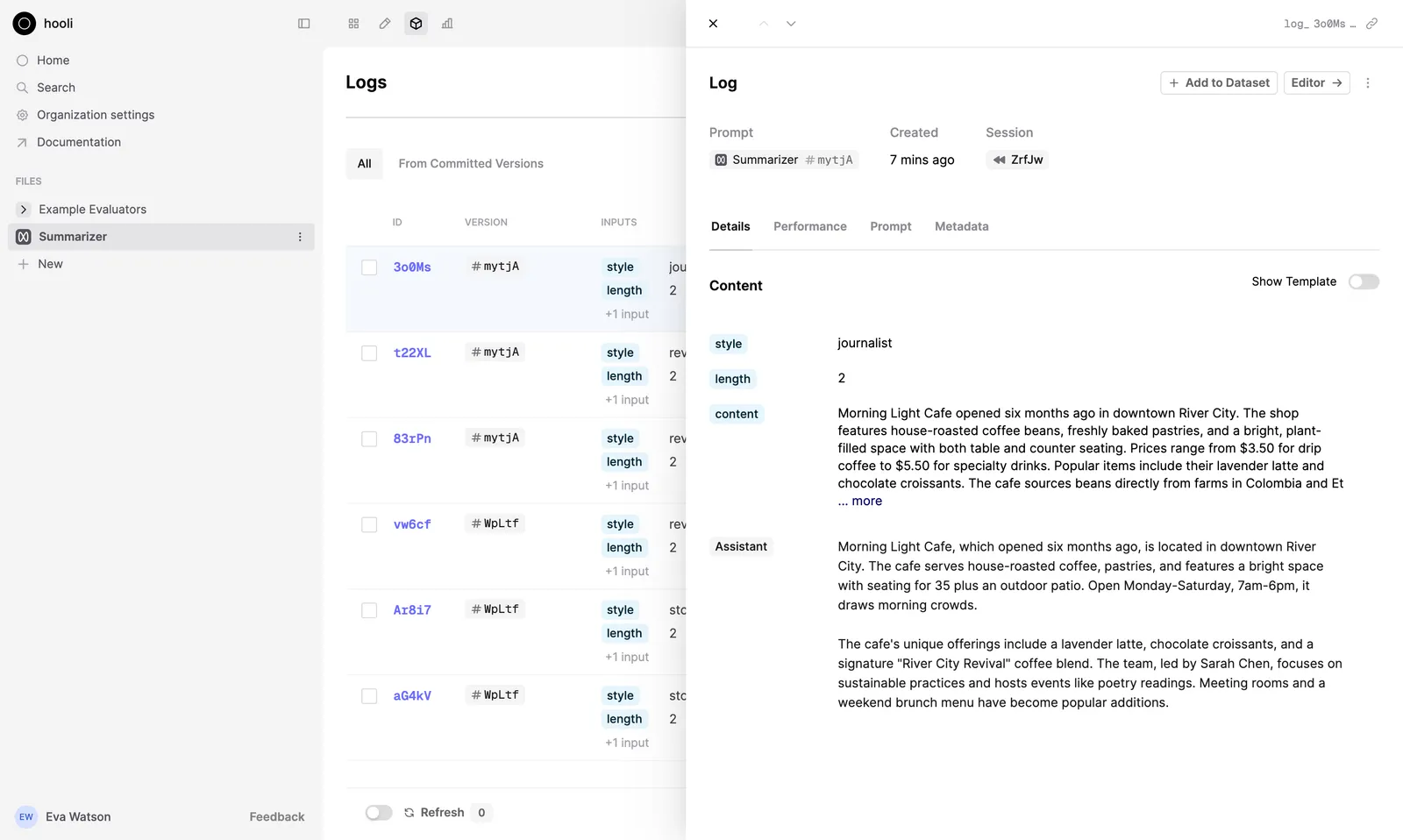
A Prompt Log of a Summarizer prompt, with inputs for summary style, length, and content.